
Casinos That Accept Direct Banking in the UK
 Available in GB
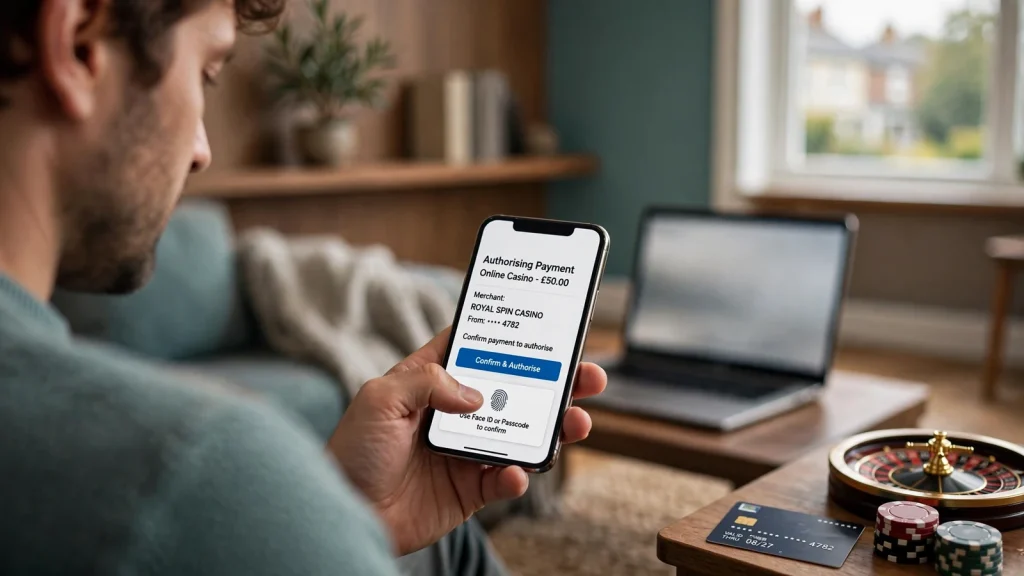
Understand how direct-banking deposits and payouts differ, what affects transfer timing and costs, and how to check a casino’s supported route.
How Open Banking connects a casino to your account
Open Banking is a way to make a payment from your bank account through a digital service that passes a payment instruction between you and the merchant. At a casino, the route normally begins in the cashier: you choose the Open Banking option, select your bank and are sent to a secure bank sign-in or approval screen. You then authorise the payment with your bank. The casino receives the payment confirmation, rather than your card number being used to make the transaction.
The key distinction is that you are approving access to a specific payment action, not handing the casino your online banking password. The bank or payment service handles the authentication. The exact screens and wording depend on the bank and the service connecting it to the casino, so the process may not look identical everywhere. Read the amount and recipient shown before approving; the fact that a payment starts from a bank account does not remove the need to check what you are authorising.
If you’re considering casinos that accept direct banking, payout timing is one practical detail to keep in view. Use the verdicts below as a brief reference and check each casino’s banking information for details not covered here.
1. BeOnBet
Payout speed: 1-3 business days
BeOnBet is listed with a payout speed of 1–3 business days.
2. EvoSpin
Payout speed: 1-3 business days
EvoSpin is listed with a payout speed of 1–3 business days.
3. Revery Play
Payout speed: 1-3 business days
Revery Play is listed with a payout speed of 1–3 business days.
4. WinBeast
Payout speed: 1-3 business days
WinBeast is listed with a payout speed of 1–3 business days.
5. Amunbet
Payout speed: 1-3 business days
Amunbet is listed with a payout speed of 1–3 business days.
6. Britsino
Payout speed: 1-3 business days
Britsino is listed with a payout speed of 1–3 business days.
7. Zombillion
Payout speed: 1-3 business days
Zombillion is listed with a payout speed of 1–3 business days.
8. x3bet
Payout speed: 1-3 business days
x3bet is listed with a payout speed of 1–3 business days.
9. Chanze
Payout speed: 1-3 business days
Chanze is listed with a payout speed of 1–3 business days.
10. SpinFormula
Payout speed: 1-3 business days
SpinFormula is listed with a payout speed of 1–3 business days.
Open Banking should not be confused with a conventional bank transfer. Both involve money moving from a bank account, but the payment route differs. With a standard transfer, you generally arrange the payment yourself through your banking service, using the recipient details supplied by the merchant. With an Open Banking payment, the casino’s payment flow links you to a bank authorisation step and sends the payment instruction through the connected service. You do not need to set up the transfer separately in your banking app by copying account details.
That distinction matters because the word “banking” can make the options sound interchangeable. A casino might offer a bank transfer, an Open Banking service, or both; the labels in its cashier identify the route being offered. A payment described as a bank transfer is not automatically an Open Banking payment, and an Open Banking option is not simply a card transaction with a bank logo attached.
A debit-card payment works differently again. You enter or select card details, and the payment is processed through the card network and issuer. Open Banking instead directs you to authorise a bank payment. It does not require you to give the casino your debit-card number. In the UK, remote gambling operators cannot accept credit-card payments for gambling, including credit-card funding routed through a money service business. A card option at a UK-licensed casino is therefore not permission to use a credit card for a gambling deposit.
UK casino sites that accept EcoPayz: what to check
A useful way to think about the Open Banking route is as a sequence: the casino requests a payment, a connecting service presents the request, your bank verifies and authorises it, and a confirmation is sent back. The casino does not need to see your bank password to receive that confirmation. Still, approval is yours to give. If the amount, recipient or payment purpose does not match what you intended, stop and check rather than approving on autopilot.
The term can also be used loosely in payment descriptions. Some services may be presented as direct banking or account-to-account payments, while the underlying route can differ. Do not assume that every option containing “bank” in its name uses Open Banking. The practical test is the payment flow: does it take you to a bank authorisation step through a connected service, or are you being asked to arrange a transfer yourself? If the explanation is unclear, check the payment provider’s description before proceeding.
The route itself says little about what happens after you authorise a payment. Open Banking is a payment mechanism, not a promise about a casino’s wider account procedures or the time taken for every transaction. A specialist review has reported that Open Banking and bank transfers can support instant deposits and fast withdrawals at many sites, but that observation should not be treated as a guarantee for a particular casino or account. The payment path and the casino’s own handling are separate parts of the experience.
For a first deposit, focus on understanding the authorisation screen and the distinction between a bank payment and a card payment. Make sure you recognise the service connecting the casino to your bank, check the details displayed, and approve only the instruction you intended to make. That gives you a clearer picture of what “Open Banking” means at the point where it matters: the moment money leaves your bank account.
Open Banking Sequence
Step 1: Request
The casino requests a payment via a connecting service.
Step 2: Verification
The connecting service presents the request to your bank for verification.
Step 3: Authorisation
Your bank verifies your identity and you authorise the payment.
Step 4: Confirmation
A confirmation is sent back to the casino to complete the transaction.
Using the same bank account for deposits and payouts
When you use Open Banking at an online casino, the account details attached to your casino profile and the bank account you select should belong to you. Keeping those details aligned can reduce avoidable questions about who is making a payment. It also makes the route easier to follow when you return to the cashier later.
A practical approach is to register with your own accurate details and use a bank account in the same name. If you have more than one personal account, choose the one you intend to use and keep to it where possible. The cleanest route is often one named account used consistently for deposits and withdrawals. Consistency does not guarantee that every transaction will be accepted without checks, but it avoids a basic mismatch that can complicate an otherwise straightforward payment.
Keep ownership details aligned
Before making a deposit, check the name on your casino account against the name held by your bank. Pay attention to ordinary differences: a shortened first name, a different surname after a change, or an old address can leave your records looking inconsistent. Correct profile details through the casino’s account settings or support channel rather than trying to work around them with another person’s payment account.
This is particularly important if you are considering using a partner’s or family member’s bank account. Permission to use someone else’s account does not make it yours, and the casino may not treat the account holder and the registered player as the same person. Using another person’s banking details can create questions about ownership that would not arise with your own account. Do not assume that a successful deposit means the arrangement will also be acceptable for later transactions.
Casinos That Accept Debit Cards in the UK
The same principle applies if you hold a joint account. A bank may allow more than one account holder to use it, but the casino’s payment checks may still need to establish that you are entitled to use the route. If the cashier’s terms do not make the position clear, ask the operator before sending money. That is simpler than trying to explain a mismatch after the payment has been made.
Avoid unnecessary changes
Switching between bank accounts can make it harder to keep your payment details straight. You may have to remember which account was used, whether the name on it matches your profile, and whether the casino allows that route for the transaction you want to make. A consistent account helps avoid those basic ownership uncertainties.
There are legitimate reasons to change accounts: you may close one, change banks, or need to correct outdated information. If that happens, update your casino profile where necessary and check the cashier’s current instructions before using the new account. Do not keep trying different accounts to see which one works. If a payment is declined or the details are questioned, stop and contact the casino or your bank through their official channels.
A change in your personal details can also call for a little housekeeping. If your name or address has changed, make sure the relevant records are current. You do not need to make payment choices more complicated than they are; the useful aim is simply for the casino account and the bank route to point to the same customer.
Do
- Use a bank account in your own name
- Align profile details with bank records
- Use one named account consistently
- Update profile details through official channels
Don’t
- Use a partner’s or family member’s account
- Try different accounts to see which works
- Use a different surname or old address
- Assume a successful deposit means any account is acceptable
What consistency can—and cannot—do
Matching account ownership details reduces the chance that a transaction is held up by a preventable question about who owns the casino account or the bank account. It does not remove other checks, and it does not guarantee that a casino will accept a particular payment route. The operator’s cashier and terms remain the place to confirm what is available for your account.
Consistency is also not a reason to overlook account security. Use your own banking access, keep your login credentials private, and do not let another person make payments through your casino profile. If someone else needs to manage their own gambling account, they should use their own details and payment arrangements.
When comparing an Open Banking casino in the UK, consider more than whether the cashier displays a bank-payment option. Check that you can use a bank account in your own name and that the account details you provide are current. Then use the same named account for deposits and, where the casino’s rules allow, withdrawals. This keeps the ownership information coherent without assuming that the payment route itself settles every question.
The point is not that every change or difference will cause a problem. It is that mismatched names and switching between accounts can create avoidable friction, while a single personal account gives you a clearer, more consistent record. When a detail does not match, resolve it before proceeding rather than relying on the payment to go through and sorting it out later.
When direct banking is instant—and when it is not
An “instant” deposit describes how quickly a payment may appear in your casino balance, not a promise that every transaction will clear immediately. Open Banking and bank transfers can support instant deposits at many sites, but availability and performance depend on the casino and the payment route offered to you. A specialist review has described these methods as capable of fast deposits and withdrawals; that is a report about possible performance, not a guarantee for every customer or transaction.
If a deposit is shown as pending, or your balance has not changed, avoid submitting it again straight away. Check the cashier and your bank account for the transaction status, then contact the casino if the payment appears to have gone through but the balance is still wrong. Repeating a payment before its status is clear could leave you with more than one transaction to resolve.
Casinos That Accept Litecoin in the UK: Payment Checks
What “instant” means in practice
For a direct-banking casino deposit, “instant” generally means the funds are credited without a noticeable wait after you authorise the payment. It does not mean the service is immune to interruptions, checks or delays. A payment may take longer than expected, and a casino may display a different status from your banking app while it is being handled.
Treat speed claims as descriptions of a possible experience, not as service guarantees. If timing matters to you, read the cashier information before depositing and note what it says about payment status and support. The important point is whether the funds have actually reached your casino balance; an authorisation screen alone is not proof that they are available to use.
The same caution applies to withdrawals. A casino may offer a direct-banking payout route and still take time to process a request. “Fast withdrawal” can refer to the payment method’s potential once a casino has released the funds; it should not be read as a promise that a request will be approved or arrive immediately. The time shown in the cashier is more useful than a broad claim on a promotional page, though it is still an estimate rather than a guarantee.
Bonuses are a separate question
Looking for an Open Banking casino with a no-deposit bonus or free spins? Do not assume that a payment method comes with either offer. A bonus is governed by the casino’s current promotion and its terms, while payment methods may be treated differently for eligibility. Check the offer rules and the cashier before making a deposit, including whether the payment option you intend to use qualifies.
If a promotion requires a deposit, confirm that requirement in the terms rather than relying on its headline. If it is described as no-deposit, check what conditions still apply before accepting it. Free spins may also be limited to particular games or subject to conditions stated by the casino. The offer’s label is not a substitute for its rules.
A payment page and a bonus page can change independently. An offer you saw earlier may no longer be available, and a method listed in a general promotion description may not appear for your account in the cashier. Make the decision using the information displayed when you are ready to act, not an old review or an assumption that every customer sees the same options.
Direct banking can be a practical way to fund an account when the casino makes it available, but speed alone is a poor basis for choosing it. Check that the transaction has completed, distinguish a quick deposit from a quick payout, and read the current offer terms separately. That is less exciting than an instant-payment promise, but more useful when money is involved.
Casinos That Accept Dogecoin in the UK
Comparing direct-banking costs before you pay
A direct payment can look free because no charge appears on the casino’s payment screen. That does not establish that the transaction costs nothing: a charge may be applied elsewhere in the payment chain or built into the exchange rate.
A specialist payment review identifies several possible cost points: the casino, the payment provider, your bank or card issuer, currency conversion and, where relevant, a payment network. Which ones apply depends on the route and the transaction. Before depositing, check the casino’s payment terms and the provider’s own fee information, then look at what your bank may charge. A fee shown by one party is only one part of the total.
The fairest comparison is for the amount you actually intend to move, in the currency you intend to use. Compare the amount leaving your bank with the amount credited to your casino balance. If the account balance is in a different currency, find out which exchange rate will be used and whether conversion happens at the casino, provider or bank. A stated flat fee is easy to spot; a less favourable exchange rate can be harder to notice and may cost more than that visible charge, as a specialist payment review cautions.
Do not assume that a payment method is the cheapest simply because it has no listed casino fee. The provider may charge separately, or your bank may apply its own fee. If currency conversion is involved, compare the quoted rate with the rate you would expect for the same currencies, and check whether the displayed amount already includes a margin. If a network charge applies to the route, include that too. The relevant figure is the combined cost, not the most prominent line on a payment page.
Casinos That Accept E-check in the UK: What to Check
There is no single lowest-cost method for every player or transaction. A specialist payment review recommends comparing casino charges, provider fees, conversion costs and network charges against the actual amount being moved. That also means a comparison made for one deposit may not settle the cost of another: changing the amount, currency or payment route can change which charges apply. Use the same amount and currency when comparing direct-banking casino sites, and record the final credited balance rather than relying on a label such as “free”.
If the casino account is offered in pounds, confirm that it will remain in pounds for your transactions. A different account currency can introduce conversion even when your bank account is sterling. Check the terms before making the payment, since changing currency later may not undo a conversion already applied.
A no-deposit bonus is not a substitute for checking payment costs: it does not tell you what a later deposit route will cost. If an offer affects your decision, read its own terms separately rather than treating it as a discount on bank charges. The practical comparison is straightforward: identify every party that may charge, confirm the currencies involved, and compare the final cost for the same intended deposit.
Checking whether a casino accepts your banking route
A payment method mentioned on a casino’s general payments page is not necessarily available to every customer. Availability can depend on your location, the details of your account and the payment product you hold. For a casino that accepts Open Banking or direct banking, the practical check is the cashier shown after you have signed in—not a broad list copied into a review.
Casinos That Accept Wirecard in the UK: What to Check
Start by opening the deposit area and looking for the exact route you intend to use. “Bank transfer”, “Open Banking” and a named banking service can describe different ways of making a payment; one does not confirm that the others are supported. If you want to connect through your bank, check that the cashier offers that route and can identify your bank before proceeding. Do not assume that a bank transfer option means an Open Banking connection is available.
A specialist review may list Visa and Mastercard among a casino’s payment options, but that does not establish current UK availability or confirm that your particular card product is eligible. Check the cashier for the option itself and read any accompanying restrictions. In the UK, remote gambling licensees cannot accept credit-card payments for gambling, including credit-card funding routed through a money service business. A card logo alone is therefore not enough: confirm that the card is an eligible debit product.
If a method is absent, greyed out or produces an error, treat it as unavailable to you unless the casino’s support team confirms otherwise. A payment list may be out of date, or the method may not be enabled for your account. Ask a specific question—whether your bank and intended payment route are supported—rather than relying on a general assurance that the site accepts banking payments. Avoid sending payment details or making a test payment simply to find out.
UK Licensing
Remote gambling licensees serving British customers must hold a valid UK Gambling Commission licence; verify the licence number on the public register before depositing.
Check the terms attached to the option before authorising it. Confirm that the payment is being made to the casino account you are using, that the currency shown is the one you expect, and that the cashier displays any applicable conditions. If the casino redirects you to a bank or payment provider, make sure the destination and amount still match what you selected. Stop if the details change unexpectedly.
Finally, establish that the site is permitted to serve customers in Great Britain before depositing. Remote gambling licensees offering services to British customers must hold the relevant UK Gambling Commission licence; check the licence number against the Commission’s public register rather than treating a payment option as evidence of regulatory status. The cashier answers whether a route appears available to you. It does not, by itself, establish that the casino is properly licensed or that every transaction using that route will be accepted.
Bank-transfer timing, currency and deposit limits
Finding a bank transfer in a casino cashier is only the first step. The amount of time before funds appear can depend on when you submit the payment, whether it falls outside the bank or operator’s processing cut-off, and whether the transaction needs currency conversion. A specialist payment guide identifies cut-off times, weekends and conversion as factors that can affect delivery. Treat any stated arrival estimate as conditional, rather than as a promise that applies to every transfer.
A payment sent near a cut-off may not be handled in the same processing window as one sent earlier. Weekend timing can also matter: a transfer submitted then may not move through every part of the process straight away. Check the cashier’s estimate and any payment instructions before confirming, and keep the transaction confirmation in case you need to check its status. If the casino or bank gives a different estimate, their instructions for that specific transaction are more relevant than a general description of bank transfers.
Credit Cards at UK Casino Sites: What the Rules Allow
Check the account currency first
The currency displayed for your casino account affects what happens when you pay from a UK bank account. A specialist review of payment options reports that GBP is supported on the pages it examined, but support can depend on the casino and the account settings available to you. Confirm the account currency in the cashier or account details before making your first payment.
If the casino account is not held in pounds, conversion may occur during the transaction. That can affect both the value credited to the casino balance and the time taken for the payment to be completed. Review the displayed amount and currency before approving the transfer; do not assume that seeing a pound value on one screen means the account itself is set to GBP.
Check the minimum and maximum
The minimum deposit is not necessarily the same across payment methods. A specialist review puts the commonly displayed starting point at £10–£20, depending on the method selected. That range is a guide, not a universal rule: the cashier’s minimum for the bank-transfer option you intend to use is the one to check before starting.
Maximum deposits can also differ. Limits may apply to an individual transaction, a day or a month, and can vary with the payment method and the status of your account. The cashier may show a limit when you select the method, while the casino’s payment terms may explain whether limits are applied over a period. Check both if you plan to deposit a larger amount, rather than splitting a payment on the assumption that doing so will avoid a restriction.
Deposit Verification
- Confirm the account currency is set to GBP
- Check the minimum deposit limit for the chosen route
- Verify the maximum deposit limit
- Review the operator’s current processing estimate
A practical check before paying is to confirm the account currency, the minimum and maximum shown for the selected route, and the operator’s current processing estimate. These details can change by method and account, so a general payment page is not a substitute for the information presented in your own cashier.
Which payment methods work for deposits and withdrawals?
A payment option shown in a casino’s cashier is not automatically available for both directions. Check the deposit and withdrawal menus separately: a method may let you add funds but not receive a payout. This distinction matters when comparing an Open Banking casino payment method with cards, mobile payments or prepaid options.
Debit cards are a familiar choice at UK casinos, with Visa and Mastercard commonly accepted. That does not mean every card product will work at every site, or that a card listed for deposits is also offered for withdrawals. Confirm the available route in the cashier before choosing it. Credit-card payments for gambling are not permitted at UK-licensed casinos.
Casinos That Accept Diners Club in the UK
Open Banking and bank-transfer options connect payment to a bank account, but the label alone does not tell you whether the casino supports withdrawals through the same route. Look for a clear withdrawal option, rather than assuming that a method used to deposit can also receive money. “Instant” describes a possible transaction experience, not proof of two-way compatibility.
Apple Pay is accepted for deposits at some UKGC-licensed casinos. Its presence as a deposit choice should not be taken as evidence that it can also be used to withdraw. If you prefer a mobile wallet, check which direction the cashier supports before making a deposit.
Paysafecard has a different role: it is a prepaid voucher for deposits, not a withdrawal route. It may suit someone who wants to pay in that way, but you will need to consider a separate payout method if you later withdraw.
The practical comparison is therefore not simply which option appears on a payment page. Check whether it supports deposits, withdrawals or both; whether the cashier currently offers it to you; and whether the payment account or card is eligible. A method can be useful for adding funds while still being unsuitable for receiving them.
TRON (TRX) Casino Comparison for UK Players
Why a fast deposit does not guarantee a fast withdrawal
A deposit and a withdrawal are separate transactions. A direct-banking payment may reach a casino quickly, but that does not mean a withdrawal request is approved and sent out at the same pace. The first step confirms that money has arrived; a payout also has to pass through the casino’s checks.
A specialist casino review notes that withdrawal timing can depend on the operator’s internal approval process and whether your account is fully verified. The review also says that a first withdrawal may take longer while verification is completed. In practice, this means an instant banking deposit is not evidence that the casino has already completed the checks needed to release a payout.
Before requesting a withdrawal, check your account for any outstanding verification request and read the cashier’s information about processing. If the operator asks for further information, the request may remain pending until the review is complete. The precise steps and timing depend on the casino, so an advertised fast withdrawal should not be read as a promise that every request will be paid instantly.
There is also a reason a direct banking casino withdrawal may not be sent to whichever destination you choose. UK anti-money laundering rules generally require payouts to go back to the original payment source. That is why a casino may route a withdrawal to the bank account used for the deposit, even if another route appears more convenient.
If your payout is delayed, distinguish between the casino’s approval and the onward payment. A request that is still being checked has not yet reached the point where the bank can deliver it. If the casino shows it as approved, consult its payment information or contact support to clarify the status. Keep the transaction details so you can refer to the same request.
Treat “instant withdrawal” as a description to verify in the operator’s terms, not a guarantee attached to an instant deposit. The practical question is whether your account is ready for a payout and what process applies after you submit the request.
Direct banking and GamStop: keep payment choice separate
A bank-linked payment option does not tell you whether a casino participates in GamStop, and it cannot change a self-exclusion choice. Searches for a direct-banking casino outside GamStop combine two separate issues: how a payment is made and whether you have chosen to block your gambling.
Casinos That Accept Bitcoin in the UK: Checks to Make
If you have self-excluded, do not use another payment route or account to try to get around that decision. A deposit going through your bank does not make an excluded account available or remove the protections you have put in place. If you are finding it difficult to stick to an exclusion, pause before depositing and use the support options available to you.
The label “not on GamStop” is not a substitute for checking a casino’s legal status. Remote gambling licensees serving the British market must hold the relevant UK Gambling Commission licence. A payment method, including direct or instant banking, is not evidence of that licence. Check the operator on the Commission’s public register before depositing.
UK-licensed casinos must provide self-exclusion and other responsible-gambling controls. They must also prompt new customers to set a financial limit before their first deposit and make account-level limit controls accessible. These safeguards are separate from the cashier: choosing a banking route does not replace them.
Treat payment convenience and account controls as different checks. If your reason for seeking a non-GamStop site is to continue gambling during a self-exclusion, the safer step is not to deposit.
Keeping direct-banking transactions clear and traceable
When a casino sends a withdrawal back through the route used for a deposit, the payment trail is easier to connect to the person who funded the account. This is not merely an administrative preference. Returning money to its original source is a common anti-fraud and anti-money-laundering control: it helps reduce the risk of a gambling account being used to move funds between people or payment channels.
That is why a direct-banking casino may not treat every alternative payout route as interchangeable with the one you used to pay in. A request to send funds elsewhere can trigger extra checks, even if the alternative account or service is yours. The casino may need to establish who controls it and why the destination differs from the original source. Further verification can add steps before a withdrawal is released; the exact requirements depend on the operator and the circumstances.
Before depositing, read the payment and withdrawal terms together, rather than treating the cashier’s deposit options as a promise about payouts. If you expect to use a particular route, check whether it can also receive withdrawals and whether the casino may ask for supporting information when the route changes. Keep records of the payment confirmation and any messages about a payout, so you can identify which transaction a request refers to.
A clear, traceable route does not guarantee that a withdrawal will be approved, but it avoids adding an unexplained change of destination to the process. If the casino asks for evidence, use its secure account channel and provide only what is relevant.
Why can a fast payout casino still delay my withdrawal?
A casino’s internal approval and account verification happen before a payout is sent, so even a fast payment method can take longer—especially for a first withdrawal.
Why must withdrawals return to the deposit method?
Returning funds to the original payment source is a common anti-fraud and anti-money-laundering control. Using another route may require additional verification.
What is the fastest withdrawal method for UK casinos?
PayPal, Open Banking services and debit cards linked to fast payout systems are generally among the quickest. The casino’s approval process and your verification status also affect how soon you receive the money.
Do UK casino withdrawals require verification?
You may need to complete verification before a withdrawal is approved; checks can make a first payout take longer. Keeping your casino and payment account details consistent can help avoid basic ownership mismatches.
Which payment methods are accepted in Great Britain?
Common options include Visa and Mastercard debit cards, PayPal, Open Banking, bank transfers and e-wallets such as Skrill and Neteller. Some casinos also accept Paysafecard for deposits, Apple Pay or Jeton; check the cashier for current availability.
Can I deposit in GBP?
Yes, GBP is supported. Confirm that your casino account is set to GBP before paying to avoid currency conversion.
What is the current minimum deposit?
The minimum deposit usually starts at £10–£20, depending on the payment method.
Which method has the lowest fees?
There is no universally cheapest method. Compare casino and provider charges, bank or issuer fees, currency-conversion spreads and any network costs for the amount you plan to deposit or withdraw.
Cashier Deposit Methods: Golden Pharaoh Casino UK
Created by the "" editorial team.